
Frequently Asked Questions
ShipVerse Logistics provides logistics and sea freight support connecting businesses with major container ports and shipping hubs across global markets. Our network covers key ports across Europe, Asia, the Middle East, North America, South America, Africa, and other international trade regions.
Our port coverage includes major locations such as:
- Turkey: Istanbul, Izmir, Mersin, Gemlik, Iskenderun, Izmit, Samsun and Trabzon
- USA: Los Angeles, New York, Houston, Savannah, Seattle, Miami, Baltimore and other major ports
- Germany: Hamburg, Bremen, Bremerhaven, Kiel, Rostock and other logistics hubs
- China: Shanghai, Ningbo, Shenzhen, Guangzhou, Qingdao, Tianjin, Xiamen and other major ports
- India: Mumbai, Chennai, Kolkata, Cochin, Kandla, Jawaharlal Nehru and Visakhapatnam
- United Kingdom: London, Liverpool, Southampton, Felixstowe, Dover and other major ports
- Italy: Genoa, La Spezia, Livorno, Naples, Trieste, Venice and other ports
- Spain: Barcelona, Valencia, Bilbao, Algeciras, Cartagena and other major ports
- Netherlands: Rotterdam, Amsterdam, Antwerp-region connections and other European logistics hubs
- Australia: Sydney, Melbourne, Brisbane, Fremantle, Adelaide and other major ports
- Canada: Vancouver, Montreal, Halifax, Toronto, Prince Rupert and other ports
- Middle East: Dubai, Jebel Ali, Abu Dhabi, Jeddah, Dammam, Kuwait, Muscat and other regional ports
- Asia: Singapore-region connections, Japan, South Korea, Indonesia, Thailand, Vietnam, Taiwan and other major trading markets
- Africa: Durban, Cape Town, Lagos, Port Harcourt and other key ports
- South America: Buenos Aires, Santos, Rio de Janeiro, Rio Grande and other major ports
Port availability and routing depend on the cargo type, origin, destination, shipping schedule, carrier services, and current operational conditions. Contact our team to discuss the most suitable port and sea freight routing for your shipment.
Air Cargo Unit Load Devices (ULDs)
Air freight shipments require suitable cargo equipment based on the type, size, volume, and weight of the shipment. At ShipVerse Logistics, we coordinate appropriate air cargo solutions according to airline requirements and cargo specifications.
L = Length | W = Width | H = Height
Main Deck Pallet
Equivalent to IATA Type 2
| Specification | Details |
|---|---|
| Internal Volume | 606 cu ft / 17.16 cu m |
| Maximum Gross Weight | 15,000 lb / 6,804 kg |
| Maximum External Dimensions | 125 × 96 × 96 in |
| Metric Dimensions | 317 × 244 × 244 cm |
| Configuration | Contoured |
LD-7
Equivalent to IATA Type 5
| Specification | Details |
|---|---|
| Internal Volume | 379.9 cu ft / 10 cu m |
| Maximum Gross Weight | 10,200 lb / 4,627 kg |
| Maximum External Dimensions | 125 × 88 × 63 in |
| Metric Dimensions | 317 × 223 × 160 cm |
P9A Lower Deck Pallet
Equivalent to IATA Type 6
| Specification | Details |
|---|---|
| Internal Volume | 242 cu ft / 6.9 cu m |
| Maximum Gross Weight | 7,000 lb / 3,176 kg |
| Maximum External Dimensions | 125 × 60 × 63 in |
| Metric Dimensions | 317 × 152 × 160 cm |
LD-11
Equivalent to IATA Type 6
| Specification | Details |
|---|---|
| Internal Volume | 242 cu ft / 6.9 cu m |
| Maximum Gross Weight | 7,000 lb / 3,176 kg |
| Maximum External Dimensions | 125 × 60 × 64 in |
| Metric Dimensions | 317 × 162 × 162 cm |
LD-8
Equivalent to IATA Type 6A
| Specification | Details |
|---|---|
| Internal Volume | 243 cu ft / 6.9 cu m |
| Maximum Gross Weight | 5,400 lb / 2,450 kg |
| Maximum External Dimensions | 96 × 60 × 64 in |
| Metric Dimensions | 228 × 152 × 162 cm |
LD-4
Equivalent to IATA Type 7A
| Specification | Details |
|---|---|
| Internal Volume | 194 cu ft / 5 cu m |
| Maximum Gross Weight | 5,400 lb / 2,450 kg |
| Maximum External Dimensions | 96 × 60 × 64 in |
| Metric Dimensions | 228 × 152 × 162 cm |
LD-3
Equivalent to IATA Type 8
| Specification | Details |
|---|---|
| Internal Volume | 150 cu ft / 4 cu m |
| Maximum Gross Weight | 3,500 lb / 1,588 kg |
| Maximum External Dimensions | 61 × 60 × 64 in |
| Metric Dimensions | 154 × 152 × 162 cm |
LD-2
Equivalent to IATA Type 8D
| Specification | Details |
|---|---|
| Internal Volume | 120 cu ft / 3 cu m |
| Maximum Gross Weight | 2,700 lb / 1,225 kg |
| Maximum External Dimensions | According to applicable LD-2 configuration and airline requirements |
Choosing the Right Air Freight Container
The appropriate ULD depends on the cargo dimensions, gross weight, volume, aircraft type, loading position, and airline requirements. ShipVerse Logistics can help coordinate the appropriate air freight equipment and transportation arrangement for your shipment.
For specific ULD availability and current airline acceptance requirements, please contact our logistics team with your cargo dimensions and weight.
Understanding International Trade Terms
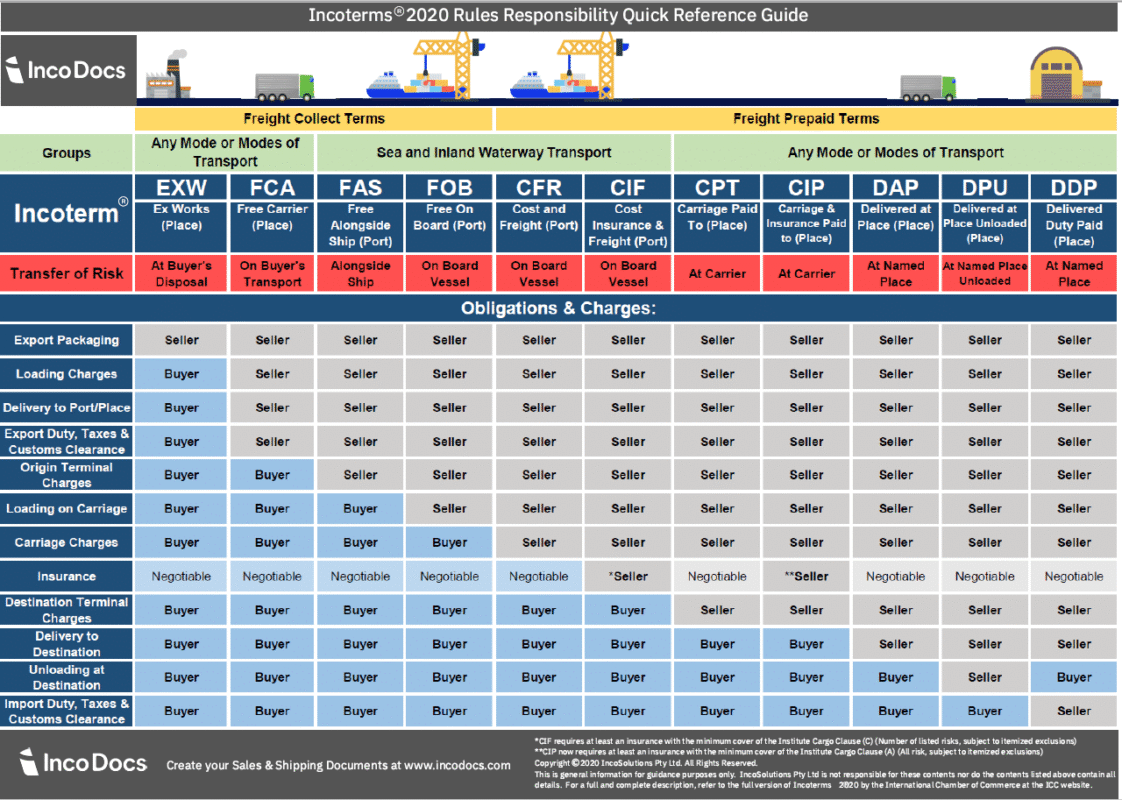
Incoterms® are internationally recognized trade terms used in contracts for the sale of goods. They help buyers and sellers clearly define their respective responsibilities for transportation, costs, delivery, and the transfer of risk during the movement of goods.
At ShipVerse Logistics, we help customers understand the logistics responsibilities associated with different Incoterms and coordinate transportation according to the agreed terms of sale.
What Do Incoterms Define?
Incoterms help clarify important responsibilities between the seller and buyer, including:
- Transportation arrangements
- Delivery responsibilities
- Allocation of transportation costs
- Point of delivery
- Transfer of risk
- Export and import clearance responsibilities
- Documentation requirements
- Insurance responsibilities where applicable
Clear agreement on the applicable Incoterm can help reduce misunderstandings between buyers, sellers, and logistics providers.
Incoterms Are Part of the Sales Contract
Incoterms® are not laws or standalone contracts. They are contractual rules that become applicable when the buyer and seller agree to use a particular Incoterm in their sales contract.
The agreed Incoterm should be clearly stated together with the named place or destination and the applicable Incoterms® edition.
For example:
FCA Bonn, Factory II, Example Street 7, Incoterms® 2020
The exact wording and named location are important because they help establish where delivery takes place and where responsibilities and risks change from one party to the other.
Buyer & Seller Responsibilities
Each Incoterm establishes a different division of responsibilities between the seller and buyer. Depending on the selected term, responsibilities may include transportation, loading, delivery, customs formalities, insurance, and other logistics arrangements.
For this reason, buyers and sellers should select the term that matches their actual commercial agreement and logistics requirements.
Common Incoterms® 2020 Rules
For Any Mode of Transport
- EXW – Ex Works
- FCA – Free Carrier
- CPT – Carriage Paid To
- CIP – Carriage and Insurance Paid To
- DAP – Delivered at Place
- DPU – Delivered at Place Unloaded
- DDP – Delivered Duty Paid
For Sea & Inland Waterway Transport
- FAS – Free Alongside Ship
- FOB – Free On Board
- CFR – Cost and Freight
- CIF – Cost, Insurance and Freight
Why Correct Incoterms Selection Matters
Choosing an appropriate Incoterm helps both parties understand who is responsible for each stage of the shipment. It can also make logistics planning, cost allocation, documentation, and risk management clearer.
However, an Incoterm should always be considered together with the complete sales contract, applicable customs requirements, and the specific circumstances of the transaction.
Plan Your Shipment with Confidence
At ShipVerse Logistics, we coordinate sea, air, road, and international logistics services according to the commercial terms agreed between the parties.
Contact our team with your shipment details and agreed Incoterm so we can help coordinate the appropriate logistics arrangements.
Full Container Load (FCL)
Full Container Load (FCL) is used when the shipment is large enough to use an entire container. The container is dedicated to the cargo of one exporter, providing a direct and organized solution for larger shipments.
FCL is suitable when the cargo volume is high or when the shipper prefers to have the container exclusively allocated to their goods. Depending on the agreed logistics arrangement, the container can be delivered to the consignee’s facility or transferred to an appropriate warehouse after arrival at the destination port.
Key Features of FCL
- One exporter generally uses the container exclusively.
- Suitable for larger-volume shipments.
- Cargo is not consolidated with unrelated shipments.
- Efficient handling for regular or high-volume cargo.
- Available for various container types and international destinations.
Less than Container Load (LCL)
Less than Container Load (LCL) is used when a shipment does not require a full container. Cargo from multiple exporters is consolidated into the same container to make better use of available container space.
At the destination, the consolidated cargo is separated and delivered according to the individual shipment arrangements and customs requirements.
Key Features of LCL
- Cargo from multiple exporters can share one container.
- Suitable for smaller-volume shipments.
- Shippers pay according to the space or volume used, subject to applicable charges.
- Provides an option when a full container is not required.
- Requires consolidation at origin and deconsolidation at destination.
FCL vs LCL
| Feature | FCL | LCL |
|---|---|---|
| Container usage | Dedicated to one shipment/exporter | Shared by multiple shipments |
| Suitable for | Larger shipments | Smaller shipments |
| Cargo consolidation | Generally not consolidated | Consolidated with other cargo |
| Handling | Fewer consolidation/deconsolidation steps | Requires consolidation and deconsolidation |
| Cost structure | Container-based | Usually based on cargo volume/weight and applicable charges |
| Ideal for | High-volume or regular shipments | Smaller or occasional shipments |
FCL/LCL Shipment Types
FCL/FCL: One exporter loads a full container for one importer.
LCL/LCL: Cargo from one exporter is shipped as LCL and delivered as an LCL shipment to the importer.
LCL/FCL: Multiple exporters’ cargo is consolidated into a container, which is then delivered to one importer.
FCL/LCL: One exporter loads the container, and the cargo is subsequently distributed to two or more importers.
Choosing the Right Option
The choice between FCL and LCL depends on cargo volume, shipment requirements, destination, handling requirements, transit arrangements, and overall transportation costs. ShipVerse Logistics can coordinate the appropriate sea freight solution based on the specific shipment requirements.
Below is a clean, professional ShipVerse Logistics version of the container specifications. You can paste this directly into your website.
20′ Dry Container (20 DC)
| Specification | Metric | Imperial |
|---|---|---|
| Internal Dimensions | ||
| Length | 5,897 mm | 19 ft 4.17 in |
| Width | 2,348 mm | 7 ft 8.44 in |
| Height | 2,390 mm | 7 ft 9.90 in |
| Door Opening | ||
| Width | 2,336 mm | 7 ft 8.01 in |
| Height | 2,280 mm | 7 ft 5.45 in |
| Weight | ||
| Max Gross | 30,480 kg | 67,200 lb |
| Tare Weight | 2,240 kg | 4,940 lb |
| Max Loading | 28,240 kg | 62,260 lb |
| Loading Volume | 33.0 m³ | 1,169 ft³ |
40′ Dry Container (40 DC)
| Specification | Metric | Imperial |
|---|---|---|
| Internal Dimensions | ||
| Length | 12,031 mm | 39 ft 5.66 in |
| Width | 2,348 mm | 7 ft 8.44 in |
| Height | 2,390 mm | 7 ft 9.90 in |
| Door Opening | ||
| Width | 2,336 mm | 7 ft 8.01 in |
| Height | 2,280 mm | 7 ft 5.45 in |
| Weight | ||
| Max Gross | 32,500 kg | 71,650 lb |
| Tare Weight | 3,750 kg | 8,270 lb |
| Max Loading | 28,750 kg | 63,380 lb |
| Loading Volume | 68.0 m³ | 2,385 ft³ |
40′ High Cube Dry Container (40 HC)
| Specification | Metric | Imperial |
|---|---|---|
| Internal Dimensions | ||
| Length | 12,031 mm | 39 ft 5.66 in |
| Width | 2,348 mm | 7 ft 8.44 in |
| Height | 2,695 mm | 8 ft 10.12 in |
| Door Opening | ||
| Width | 2,336 mm | 7 ft 8.01 in |
| Height | 2,585 mm | 8 ft 5.75 in |
| Weight | ||
| Max Gross | 32,500 kg | 71,650 lb |
| Tare Weight | 3,940 kg | 8,690 lb |
| Max Loading | 28,560 kg | 62,960 lb |
| Loading Volume | 76.0 m³ | 2,689 ft³ |
45′ High Cube Dry Container (45 HC)
| Specification | Metric | Imperial |
|---|---|---|
| Internal Dimensions | ||
| Length | 13,555 mm | 44 ft 5.68 in |
| Width | 2,348 mm | 7 ft 8.44 in |
| Height | 2,695 mm | 8 ft 10.12 in |
| Door Opening | ||
| Width | 2,336 mm | 7 ft 8.01 in |
| Height | 2,585 mm | 8 ft 5.75 in |
| Weight | ||
| Max Gross | 32,500 kg | 71,650 lb |
| Tare Weight | 4,880 kg | 10,760 lb |
| Max Loading | 27,620 kg | 60,890 lb |
| Loading Volume | 86.0 m³ | 3,031 ft³ |
Refrigerated Containers
20′ Reefer Container (20 RF)
| Specification | Metric | Imperial |
|---|---|---|
| Internal Dimensions | ||
| Length | 5,458 mm | 17 ft 10.76 in |
| Width | 2,290 mm | 7 ft 6.16 in |
| Height | 2,262 mm | 7 ft 5.06 in |
| Door Opening | ||
| Width | 2,290 mm | 7 ft 6.16 in |
| Height | 2,267 mm | 7 ft 5.10 in |
| Weight | ||
| Max Gross | 30,480 kg | 67,200 lb |
| Tare Weight | 3,120 kg | 6,880 lb |
| Max Loading | 27,360 kg | 60,320 lb |
| Loading Volume | 28.0 m³ | 1,000 ft³ |
40′ Reefer Container (40 RF)
| Specification | Metric | Imperial |
|---|---|---|
| Internal Dimensions | ||
| Length | 11,587 mm | 38 ft 0.29 in |
| Width | 2,290 mm | 7 ft 6.16 in |
| Height | 2,539 mm | 8 ft 4.00 in |
| Door Opening | ||
| Width | 2,290 mm | 7 ft 6.16 in |
| Height | 2,572 mm | 8 ft 5.40 in |
| Weight | ||
| Max Gross | 34,000 kg | 74,960 lb |
| Tare Weight | 4,700 kg | 10,360 lb |
| Max Loading | 29,300 kg | 64,595 lb |
| Loading Volume | 67.0 m³ | 2,378 ft³ |
Open Top Containers
20′ Open Top Container (20 OT)
| Specification | Metric | Imperial |
|---|---|---|
| Internal Dimensions | ||
| Length | 5,893 mm | 19 ft 4.21 in |
| Width | 2,346 mm | 7 ft 8.36 in |
| Height | 2,384 mm | 7 ft 9.74 in |
| Door Opening | ||
| Width | 2,338 mm | 7 ft 8.05 in |
| Height | 2,244 mm | 7 ft 4.35 in |
| Weight | ||
| Max Gross | 30,480 kg | 67,200 lb |
| Tare Weight | 2,320 kg | 5,120 lb |
| Max Loading | 28,160 kg | 62,080 lb |
| Loading Volume | 33.0 m³ | 1,155 ft³ |
40′ Open Top Container (40 OT)
| Specification | Metric | Imperial |
|---|---|---|
| Internal Dimensions | ||
| Length | 12,032 mm | 39 ft 5.31 in |
| Width | 2,346 mm | 7 ft 8.36 in |
| Height | 2,381 mm | 7 ft 9.74 in |
| Door Opening | ||
| Width | 2,338 mm | 7 ft 8.05 in |
| Height | 2,244 mm | 7 ft 4.35 in |
| Weight | ||
| Max Gross | 30,480 kg | 67,200 lb |
| Tare Weight | 4,120 kg | 9,080 lb |
| Max Loading | 26,360 kg | 58,120 lb |
| Loading Volume | 66.0 m³ | 2,346 ft³ |
Flat Rack Containers
20′ Flat Rack Container (20 FR)
| Specification | Metric | Imperial |
|---|---|---|
| Internal Dimensions | ||
| Length | 5,958 mm | 19 ft 4.17 in |
| Width | 2,018 mm | 6 ft 7.45 in |
| Height | 2,077 mm | 6 ft 9.77 in |
| Door Opening | Not applicable | Not applicable |
| Weight | ||
| Max Gross | 30,480 kg | 67,200 lb |
| Tare Weight | 2,720 kg | 6,000 lb |
| Max Loading | 27,760 kg | 62,120 lb |
| Loading Volume | 25.0 m³ | 882 ft³ |
40′ Flat Rack Container (40 FR)
| Specification | Metric | Imperial |
|---|---|---|
| Internal Dimensions | ||
| Length | 11,986 mm | 39 ft 3.89 in |
| Width | 2,236 mm | 7 ft 4.03 in |
| Height | 1,968 mm | 6 ft 5.48 in |
| Door Opening | Not applicable | Not applicable |
| Weight | ||
| Max Gross | 45,000 kg | 99,210 lb |
| Tare Weight | 5,980 kg | 13,180 lb |
| Max Loading | 39,020 kg | 86,030 lb |
| Loading Volume | 53.0 m³ | 1,862 ft³ |
Important Note
Container dimensions, maximum gross weight, tare weight, and payload can vary depending on the container manufacturer, equipment specification, carrier, and applicable regulations. The figures above should therefore be treated as reference specifications and confirmed for the specific container and shipment before booking.
Understanding Dangerous Goods in Transportation
Dangerous goods are substances or articles that may present risks to people, property, the environment, or transportation operations because of their chemical or physical properties. International regulations classify dangerous goods into nine classes, based on the type of hazard they present.
The classification helps determine the appropriate packaging, labeling, documentation, handling, storage, and transportation requirements.
CLASS 1 — EXPLOSIVES
Explosives are substances or articles capable of producing an explosive reaction, generating intense heat, gases, pressure, or other hazardous effects.
They require specialized handling, packaging, segregation, and transportation procedures.
Examples include: fireworks, ammunition, detonators, certain explosive chemicals, and other regulated explosive articles.
Divisions of Class 1
- Division 1.1 – Substances and articles with a mass explosion hazard.
- Division 1.2 – Substances and articles with a projection hazard.
- Division 1.3 – Substances and articles presenting a fire hazard with a minor blast or projection hazard.
- Division 1.4 – Substances and articles presenting no significant hazard beyond the package.
- Division 1.5 – Very insensitive substances with a mass explosion hazard.
- Division 1.6 – Extremely insensitive articles without a mass explosion hazard.
CLASS 2 — GASES
Class 2 covers gases transported under pressure or in other regulated forms.
Class 2.1 — Flammable Gases
Gases that can ignite when exposed to an ignition source.
Examples: Acetylene, hydrogen, methane, propane and ethylene.
Class 2.2 — Non-Flammable, Non-Toxic Gases
Gases that are neither flammable nor toxic but may present pressure or asphyxiation hazards.
Examples: Nitrogen, helium, carbon dioxide and compressed air.
Class 2.3 — Toxic Gases
Gases that may cause serious health effects or poisoning when inhaled.
Examples: Chlorine, ammonia and certain toxic industrial gases.
CLASS 3 — FLAMMABLE LIQUIDS
Flammable liquids are liquids capable of producing flammable vapors and igniting under specified conditions.
They require appropriate packaging, labeling, segregation, and protection from ignition sources.
Examples: Gasoline, certain solvents, paints, thinners and other regulated flammable liquids.
CLASS 4 — FLAMMABLE SOLIDS; SUBSTANCES LIABLE TO SPONTANEOUS COMBUSTION; SUBSTANCES THAT EMIT FLAMMABLE GASES WHEN WET
Class 4.1 — Flammable Solids
Solids that can readily ignite or contribute to fire through friction, heat, or other sources of ignition.
Examples: Certain metal powders, matches, sulfur and red phosphorus.
Class 4.2 — Substances Liable to Spontaneous Combustion
Materials that may heat up and ignite spontaneously under certain conditions.
Examples: Certain charcoal products, oily materials and self-heating substances.
Class 4.3 — Substances Which Emit Flammable Gases When in Contact With Water
Substances that react with water and release flammable gases.
Examples: Certain metal hydrides, sodium, calcium carbide and other water-reactive materials.
CLASS 5 — OXIDIZING SUBSTANCES AND ORGANIC PEROXIDES
Class 5.1 — Oxidizing Substances
Oxidizing substances can cause or intensify combustion by releasing oxygen or supporting combustion.
Examples: Certain nitrates, chlorates and other oxidizing chemicals.
Class 5.2 — Organic Peroxides
Organic peroxides can be thermally unstable and may present fire, decomposition, or reaction hazards.
They require controlled handling, appropriate packaging, and temperature management where applicable.
Examples: Certain organic peroxide compounds used in industrial and manufacturing processes.
CLASS 6 — TOXIC AND INFECTIOUS SUBSTANCES
Class 6.1 — Toxic Substances
Substances that may cause serious injury, illness, or death if swallowed, inhaled, or absorbed through the skin.
Examples: Certain pesticides, cyanide compounds, arsenic compounds, mercury compounds and other toxic chemicals.
Class 6.2 — Infectious Substances
Substances containing pathogens or materials reasonably expected to contain pathogens that can cause disease in humans or animals.
Examples: Certain diagnostic specimens, cultures, clinical samples and regulated medical materials.
CLASS 7 — RADIOACTIVE MATERIAL
Radioactive materials contain radionuclides and can present radiation hazards during transportation.
They require specialized packaging, labeling, documentation, handling, and regulatory controls.
Examples: Certain radioactive medical, industrial, research, and nuclear materials.
CLASS 8 — CORROSIVE SUBSTANCES
Corrosive substances can cause serious damage to living tissue or corrode metals and other materials.
They require suitable packaging and careful handling to prevent leakage, exposure, and damage to other cargo.
Examples: Hydrochloric acid, sulfuric acid, nitric acid, and certain corrosive alkaline substances.
CLASS 9 — MISCELLANEOUS DANGEROUS SUBSTANCES AND ARTICLES
Class 9 covers dangerous substances and articles that present transportation hazards but do not fall within Classes 1–8.
Examples include: Lithium batteries, dry ice, environmentally hazardous substances, and certain other regulated articles.
Dangerous Goods Transportation
The transportation of dangerous goods is subject to applicable international, national, carrier, port, and regulatory requirements. Classification alone does not determine whether a shipment can be accepted.
Before transportation, the proper shipping name, UN number, hazard class/division, packing group where applicable, packaging, labeling, documentation, quantity, and applicable transport mode requirements should be confirmed.
ShipVerse Logistics can coordinate dangerous goods transportation requirements according to the applicable shipment details and regulatory conditions.
L = Length, W = Width, H = Height, m³ = Total Volume (Cubic Meter)
Below is a clean ShipVerse Logistics version for your website.
| TRUCK TYPE | L (m) | W (m) | H (m) | VOLUME (m³) |
|---|---|---|---|---|
| Tilt Truck | 13.60 | 2.42 | 2.40 | 79 |
| Tilt Truck – High Volume | 13.60 | 2.42 | 2.60 | 86 |
| Jumbo Truck | 3.10 | 2.42 | 2.55 | 79 |
| Standard Truck | 9.10 | 2.42 | 2.75 | — |
| Standard Truck | 3.50 | 2.42 | 2.45 | — |
| Standard Truck | 8.70 | 2.42 | 2.95 | — |
| Normal with Trailer TIR (Optima) | 6.20 | 2.42 | 2.50 | — |
| Normal with Trailer TIR (Optima) | 8.30 | 2.42 | 2.50 | 87 |
| Jumbo with Trailer | 7.80 | 2.44 | 2.85 | 110 |
| Jumbo with Trailer | 8.10 | 2.44 | 2.85 | — |
| Normal Open Trailer | Up to 18.00 | 2.44 | — | — |
| Truck with Dumper | — | — | — | Up to 25 |
| Jumbo Open Trailer | Up to 18.00 | 2.44 | — | — |
| Lowbed Truck | — | — | — | — |
Important Note
Truck dimensions and loading capacities may vary depending on the vehicle type, trailer configuration, carrier, equipment specifications, and applicable road regulations. The above figures should be treated as reference values and confirmed for the specific shipment before transportation.
ShipVerse Logistics can coordinate suitable road freight equipment according to cargo dimensions, weight, volume, loading requirements, and destination.
When calculating transportation costs, cargo volume can be as important as cargo weight. Depending on the mode of transportation and the type of shipment, freight charges may be determined using either the actual weight, volumetric weight, or the applicable chargeable weight.
Sea Cargo Volume Calculation
For sea freight, cargo volume can be calculated using the following formula:
Volume (m³) = Length (cm) × Width (cm) × Height (cm) ÷ 1,000,000
Example
If the cargo dimensions are:
- Length: 200 cm
- Width: 100 cm
- Height: 100 cm
Volume = 200 × 100 × 100 ÷ 1,000,000 = 2.00 m³
Chargeable Weight for Partial Sea Cargo
For LCL / partial sea freight, the applicable charge may depend on the relationship between cargo volume and weight.
As a general reference, where the cargo weight exceeds the applicable weight equivalent of its volume, the actual weight may be considered for freight calculation.
Volume & Weight Conversion Reference
| Mode of Transport | Volume Basis | Weight Equivalent |
|---|---|---|
| Air Freight | 1 m³ | 167 kg |
| Truck & Air | 1 m³ | 167 kg |
| Land Freight | 1 m³ | 333 kg |
| Sea Freight | 1 m³ | 1,000 kg |
How to Use the Conversion
The above figures can be used as a reference for comparing cargo volume and weight when determining the applicable chargeable basis.
For example, for air freight:
1 m³ = 167 kg volumetric equivalent
Therefore:
3 m³ × 167 kg = 501 kg
The applicable chargeable weight may then depend on the carrier’s tariff and whether the actual or volumetric weight is greater.
Important: Actual freight calculations can vary by carrier, route, cargo type, service, and applicable tariff. The final chargeable weight should always be confirmed with the carrier or logistics provider before booking.